Blog
How to Start a Kraft Banner Business
What we've learned watching painters in this niche figure it out.
- Business
- Pricing
- Workflow
What we've learned watching painters in this niche figure it out.
Hand-painted kraft banners had their Pinterest moment in 2024, and the moment hasn’t ended. The number of new Etsy shops painting them roughly tripled over the next year. Full-time painters now charge $55 to $135 a banner, seasonal peaks can pack a calendar in three weeks, and a community of makers has figured most of it out the hard way.
If you’ve searched “how to start a kraft banner business,” you’ve already seen what’s out there: craft tutorials dressed up as business guides, or generic Etsy advice that doesn’t know the craft. Nobody names paper weights. Nobody benchmarks prices. Nobody talks about the things that quietly eat your margin in the first six months.
We build tools for kraft banner painters, which means we spend our days talking to people who do this for a living, watching what trips up new shops, and noticing what stops mattering once you’ve shipped fifty banners. The numbers and brand names below are current as of mid-2026.
Most “how to start” posts will tell you to pick a niche and commit. In practice, your clients pick the niche for you. Whoever sends the first inquiry decides whether your first paid banner is a baby shower, a 40th, or a graduation. The point of knowing each occasion isn’t specialization. It’s knowing what you’re walking into when each kind of inquiry lands.
Baby showers run year-round but spike in March and April, then again from August through October. The wording is forgiving (almost always a name and a short phrase), and motifs are usually two or three: florals, fruit, the occasional cherry-on-top. The buyer is usually the friend hosting, not the parent, which means decisive answers and faster approvals than other categories. They’re photogenic too. A baby shower banner gets posted to Instagram three times before the cake comes out.
Birthdays are the bulk of the work and the most variable. A first birthday and a 40th are completely different products for completely different buyers. The 1–3 year range overlaps heavily with baby shower aesthetics: same pastels, same scallops, same cake-smash energy. Adult milestone birthdays (30, 40, 50) want cleaner typography and tend to come with photographic references attached.
Bridal showers and engagements are heavy on lettering and light on motifs. Buyers will send Pinterest boards and an invitation to match. These are quick to paint but high on revision risk, because the bride is usually a third party in the conversation and her opinion lands late.
Graduation banners are seasonal in the cleanest way. Almost everything ships in the last two weeks of April through mid-June. The banners themselves are easy (name, year, sometimes a school color), but the volume can crush a one-person shop without a strict order cap. Plenty of painters cap at fifteen graduation banners and turn the rest away with a polite waitlist email.
Grand openings and corporate events sit apart from the rest. Bigger budgets, faster turnaround expected, less flexibility on revisions. Many painters in this niche take one or two a quarter and let them pay for the slow weeks.
Pick the one or two you’d most want in your portfolio and feature them in your shop. Take everything else as it comes.
Once you’ve put up a listing or posted on Instagram, organization pays off fast. The first inquiry that asks “can you do a 6-foot banner for May 4 with sage green and eucalyptus?” is the moment you’ll wish you’d written down a process.
Don’t overthink the system. A notebook works. A Google Sheet works. A Tally form works (free, easy, looks fine on phones), and so does a Google Form if you don’t mind the styling. The platform matters less than the questions. As you take more orders, you’ll notice which questions you keep wishing you’d asked, and the form will tighten up on its own.
A useful intake collects, in this order:
Question seven is the one most shops skip and the one that prevents the most repaints. Some clients don’t want a specific name spelled out before the event. Some are avoiding a color the in-laws hate. Some don’t want any animals on a banner that’s also serving as a backdrop for cake photos. Asking up front is faster than guessing and cheaper than reprinting.
After the brief comes the layout. The standard play is a digital mockup within 48 hours, built in Procreate or Canva. Include one round of revisions. Bill anything past that at $10 to $20 per round, and put the policy in writing. You’ll almost never charge it. The policy itself is what ends the back-and-forth.
Every banner pricing post online quotes the same range, $30 to $200 depending on size and detail, and the range is technically accurate and almost completely useless. Pricing depends on three things you can measure: paper cost, painting time, and how many revisions you’ll absorb before billing for them.
We keep the deeper pricing breakdown in How Much To Charge For Hand-Painted Kraft Banners, including size tiers, Etsy fees, shipping, rush orders, and revision rules.
For materials, a 36-inch by 100-foot roll of 55lb brown kraft from PerkHomy on Amazon runs about $34 and yields roughly 16 banners. FolkArt acrylic plus a base layer of Plaid Multi-Surface white is about $1 of paint per banner. Painter’s tape and a chalk pencil bring raw materials to about $3.50. Add $14 for a heavy-duty cardboard tube and UPS Ground, and you’re at $17.50 in cost-of-goods on a banner before you’ve touched a brush. Local pickup removes the shipping line.
Painting time scales fast with size and detail. A 5-foot banner with one phrase and three small motifs takes an experienced painter about 4 hours, including projector setup and cleanup. The same banner takes a beginner closer to 7. A 7-foot banner with dense lettering, two motifs, and a border lands around 9 hours. While a coat dries you’ll work on something else, but the calendar doesn’t stop, which is why nobody honest in this niche promises same-day rush.
Flat rates feel simple but get expensive once you take a 7-foot job for the same money as a 4-footer. Most full-time painters land at size tiers, something like 4ft $65, 5ft $85, 6ft $110, 7ft $135, for exactly that reason. The established shops on Etsy publish similar curves, usually scaling more gradually at the larger sizes. Tiers protect you from the silent escalation where “could we add just one more thing” becomes 90 minutes you didn’t quote.
The arithmetic on a representative job: a 5-foot banner at $85, with 4 hours of paint time, $3.50 in materials, $14 shipping, plus Etsy’s 6.5% transaction fee and 3% payment processing, nets the painter about $59. Divided by paint time alone, that’s $14.75 an hour. Divided by total time including the intake conversation, the mockup, and the email back-and-forth, it’s closer to $11. Plan around the second number.
The viral hand-painted banner aesthetic is built on a few small techniques nobody puts in their materials list. Worth knowing all of them before you spend two hours figuring out why your lettering looks wobbly.
A foundation brush or eyeshadow brush works better than a small paintbrush for filling in lettering on kraft. The bristles are dense enough to lay down opaque acrylic without streaking, and a pack of ten runs about $8.
White chalk pencils sketch lines that disappear under paint. A regular pencil shows through, especially under lighter colors. Colored chalk pencils sometimes bleed, so stick with white.
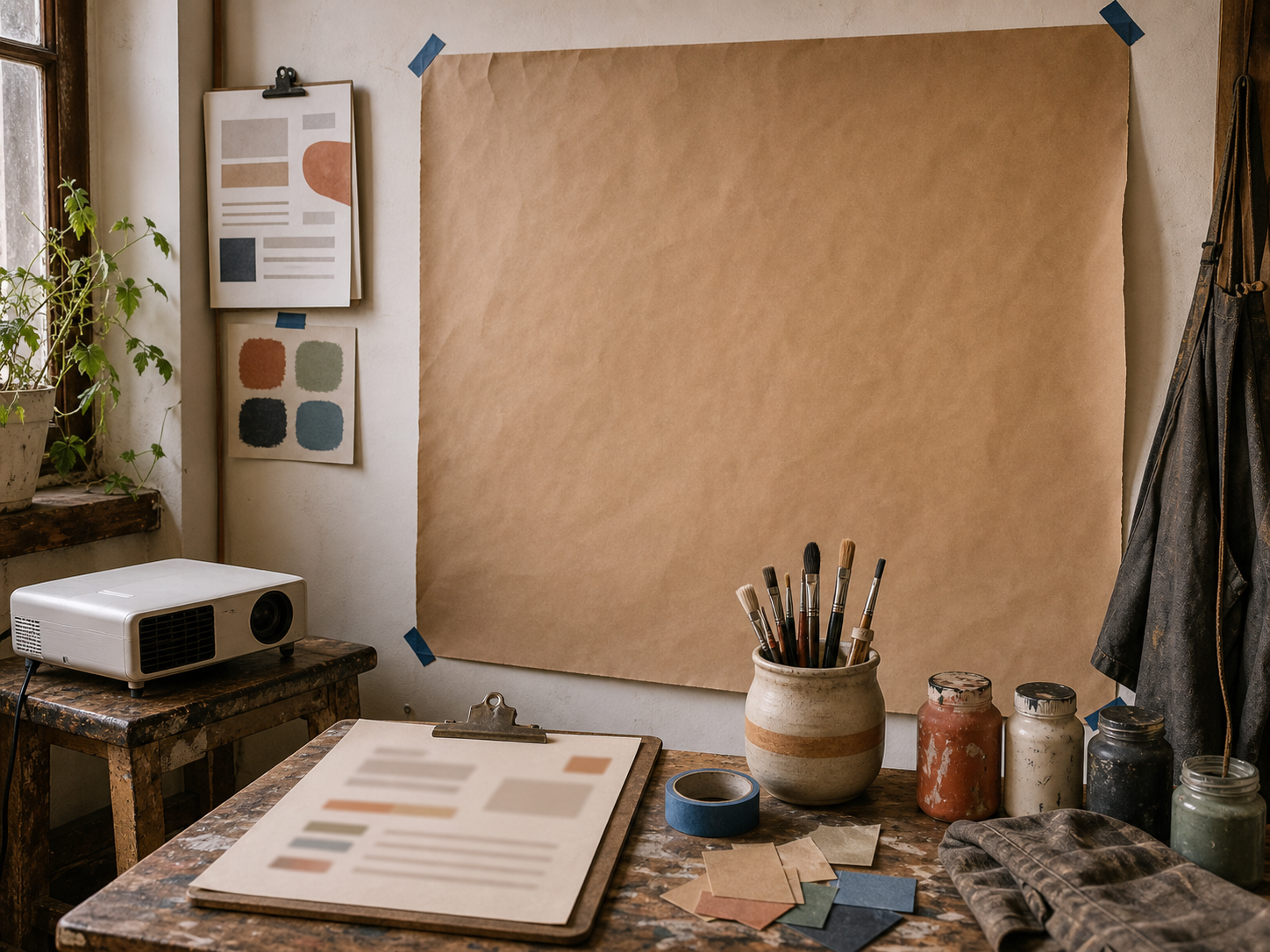
Painter’s tape rolled sticky-side-out and stuck to a wall lets you mount the paper vertically and paint standing up. You stay aligned with the lettering, you can step back to check spacing, and the paper dries on the wall without curling. It’s the kind of trick that doesn’t sound like much until you try it.
A mini projector beaming a Procreate or Canva mockup onto the mounted paper saves more time than any other piece of equipment in this workflow. A sub-$100 model like the ELEPHAS Q9 is plenty for tracing.
Paper choice is the part beginners most often get wrong. Heavyweight kraft at 55lb (about 80gsm) is the standard. Anything below 40lb warps when acrylic hits it, the kind of curl that doesn’t come out no matter how long you weight the corners. Contractor’s paper from the paint aisle at Home Depot or Lowe’s is a sturdy alternative and runs cheaper per square foot, though the brown is a slightly cooler tone that some clients don’t love.
Most of what goes wrong in this work happens before paint touches paper, or after it’s left your hands. Across what painters tell us most often, the same five patterns repeat.
Shipping curl. A banner rolled too tight into a 3-inch tube comes out with a curl that doesn’t relax. The fix is a 4-inch diameter tube, which costs about $2 more per banner and almost eliminates the problem.
Tone mismatch. A brief that says “playful” and a family that reads “playful” differently than you do. The cheapest fix is the digital mockup step, plus naming three example shops or moodboards in the intake instead of one adjective.
Misspelled names. This is the one that hurts, because it ships, gets photographed, and lives forever on someone’s grid. The fix is procedural: put the name in the subject line of the approval email, in all caps, with a “please verify spelling” note above the mockup. The shops that add this step almost never ship a misspelling.
Late delivery from carrier delays. UPS will reimburse the shipping cost on a misrouted package, but the event has already happened. Partial refunds and fast communication save the review more often than they save the relationship. Building two extra business days into every quoted timeline absorbs most of these.
Revision creep. A bride’s mom emails after the banner ships to say the script was “too casual.” A mockup approved by the bride gets overruled by a maid of honor. The fix is procedural: only the original purchaser’s approval counts, said clearly in your policy and acknowledged at intake.
A clearer intake, a more obvious approval step, and a sturdier shipping tube prevent four of the five before they happen.
You’re going to get requests for Disney characters, sports team logos, and Taylor Swift lyrics. Painting copyrighted designs for resale isn’t allowed, technically. In practice, almost nobody at a baby shower is calling Disney’s legal team, and a one-off “Hakuna Matata” banner sold on Etsy is unlikely to land you in court.
The painters who do run into trouble usually built a brand around someone else’s IP. Marvel characters as the headline of the shop. Taylor lyrics as the most-pinned listing. The whole feed leaning on stuff they don’t own. Painters who occasionally accommodate a request without making it their identity are mostly fine. So take the request you want, skip the one that makes you uneasy, and don’t put either at the center of your marketing.
When you do want to decline, usually for an obvious logo or a request that feels too risky, the polite version is short:
“I’m so glad you reached out! I don’t paint copyrighted characters or logos because the licensing rules don’t allow it for resale. I’d love to do a custom design in the same color palette and theme. Want me to send a few sketches?”
The reframe is what carries it. You’re offering an alternative that gets them most of what they wanted, which works in nearly every case.
On song lyrics specifically: two or three words used as a short phrase (“Sweet Caroline,” “Here Comes the Sun”) are usually fine. Full verses are a different category. If in doubt, treat the lyric like a quote and limit it to a phrase the client could plausibly have written themselves.
Once consistent money is landing every month, it’s time to graduate from “I’ll figure out the receipts later” to a system. Two parts: sales tax and expense tracking.
Etsy collects and remits sales tax in almost every U.S. state on your behalf, which handles most of the obligation for most painters. Off-Etsy channels (Shopify, Squarespace, in-person at markets) don’t get this for free. Technically you’ll need a state seller’s permit and you’ll need to file periodically, even in months where nothing sold. Realistically, for a few craft fair sales on the side, the IRS isn’t knocking. Once you’re consistently selling off-platform, get the permit and set up the filing.
Expense tracking is where the money is. Track everything from the first banner: paper, paint, brushes, the projector, cardboard tubes, a percentage of your home internet, the Etsy fees themselves. A Google Sheet works fine in year one. Wave or QuickBooks is worth the upgrade once you’re handling more than a couple of orders a week, mostly because they pull the numbers in for you instead of you copying them out of every receipt.
When tax time comes, you don’t need to file anything fancy yourself. Hand your accountant the spreadsheet (or the Wave export). They’ll tell you how much you can deduct. The deductions add up to a few hundred dollars on your return that you’d otherwise leave on the table.
Save every finished banner with the brief, the price, the actual hours, and the photo. After 30 to 50 jobs, patterns start to show that aren’t visible at 10. The painters who track this consistently report the same things: certain occasions are 25 to 30% faster than others once they have volume in them, average revision counts vary by occasion (bridal showers run high, baby showers run low), and there’s usually a banner size below which the math stops working once shipping is included.
The archive is also what you send a venue asking for past work, what becomes Instagram content on a slow Tuesday, and what reminds you what you used to charge before you raised your prices.
The hand-painted kraft banner style took off on Pinterest in early 2024 and went fully mainstream in 2025. It isn’t disappearing. The easy phase of the market is probably ending, though. The count of new Etsy shops painting them tripled in the last year, and buyers who paid $120 for a basic banner in 2024 will start comparing three quotes in 2026.
That sorts the market. Painters who treat this like a craft business with a recognizable style, tracked numbers, and a tight workflow will keep growing. Painters who treat it like a viral side hustle will plateau. The difference shows up in the quote-writing speed, the consistency of the lettering, and whether banners arrive flat.
We built BannerKraft for this workflow specifically: intake to layout to projector-ready in one place. If you want to try it, it’s here.
About the author
Editorial Team
The BannerKraft Editorial Team writes about the working details behind custom kraft banner jobs: pricing, client intake, paint-ready layout planning, projection workflows, and the small operational choices that protect a maker's time.