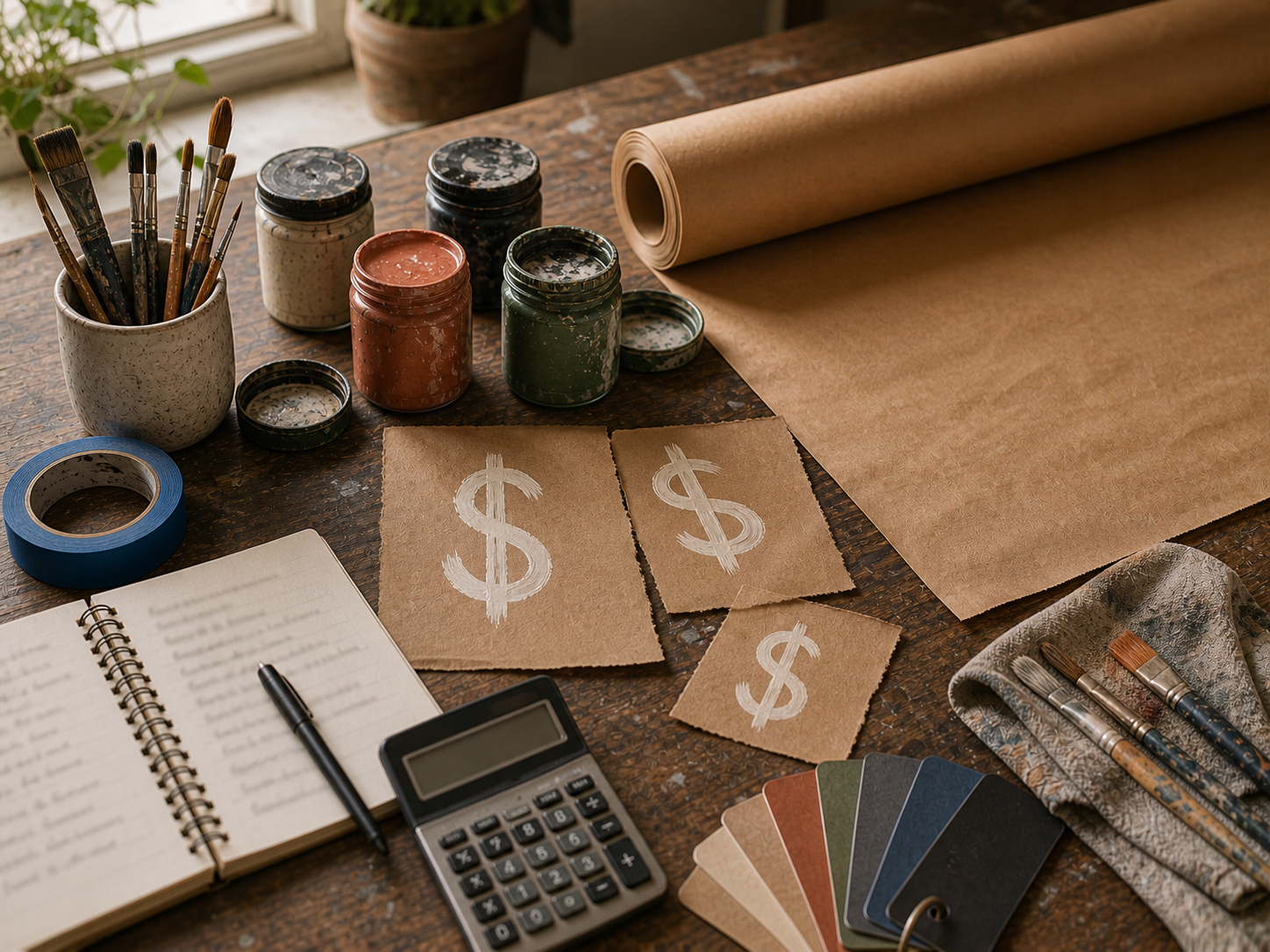
Most painters undercharge for a very normal reason: they count the part they can see, the brush time.
That is the trap in hand-painted kraft banner pricing. A client sees a brown paper party banner and thinks “cute sign.” You know there is more inside the job: intake, wording cleanup, references, layout, proof, revision, projection setup, painting, drying, photos, packing, shipping, and the message you answer three days later asking whether sage green can be “a little less sage.”
The public market is messy, which is frustrating when all you want is a fair starting price. Search Etsy or independent shops and you will see hand-painted kraft banners around $30, $45, $65, $85, $125, and sometimes more. When we scanned listings in May 2026, the low numbers usually had fine print attached: smaller sizes, pickup windows, proof timing, limited detail, or an extra charge once the client asked for more than a phrase and a few small motifs. Some of those prices are real. Some are printed banners that only look hand-painted. Some include shipping. Some quietly charge more when the client asks for dense florals or extra names.
So the better question for your shop is simple: what is the lowest price you can charge without training your business to lose money?
We last checked the numbers below in May 2026.
The short answer
If you need a menu today, start here:
|
Banner type |
Starting price |
Good for |
|
Small local pickup |
$55-$75 |
3-4 ft, one phrase, light detail, no shipping |
|
Standard party banner |
$85-$125 |
3x5 or 4x5 birthday, shower, bachelorette, graduation |
|
Larger or denser banner |
$130-$180 |
6-7 ft, longer wording, more motifs, border work |
|
Rush, corporate, or heavy illustration |
Quote it, often $200+ |
Brand work, tight deadlines, complex references |
Treat that menu as a starting point, then adjust for the job in front of you.
If you are brand new, local, and building a portfolio, a simple 3x3 banner at $55 can be a perfectly reasonable portfolio price. If you are shipping through Etsy, doing a digital proof, painting a five-foot custom design, and answering client messages, $55 is usually closer to practice with a shipping label than a business.
The healthy middle for a custom 3x5 or 4x5 hand-painted kraft banner is usually $85-$125 before rush fees or heavy detail. The higher end is where you start counting the whole job.
Why the market looks cheaper than it is
Public prices are hard to read because banner listings are not all selling the same thing.
A $30 banner may be a 3x3 pickup order from a local studio that already has a tight workflow. It may also be a low starting price that changes by size. A $45 Etsy result may be a small hand-painted piece, a sale price, or a listing where “free shipping” is built into a thinner margin. A $65 3x5 banner may be a standard design with limited changes. A $100-$135 banner may include a larger size, a more developed proof, or a seller who has learned exactly how much time client work takes.
That kind of search page can make a new seller panic. You see the lowest visible number and assume that is the market.
Slow down before you do that.
Competitor prices are useful for context, but they are not your formula. Before you copy a price, ask:
-
What size is included?
-
Is shipping included or charged separately?
-
Is it local pickup only?
-
Is a proof included?
-
How many revisions are included?
-
Are extra characters, logos, mascots, or dense motifs billed separately?
-
Is this a true custom order or a modified standard design?
-
Is the seller using this as a portfolio-building price?
Two listings can both say “custom hand-painted kraft banner” and have completely different economics. Price the version you are actually delivering.
Start with the floor
Your floor is the point where the job stops making sense. It sits below your dream price and below the price your favorite seller gets, but once a quote drops under it, your calendar fills up and the business gets weaker.
The simplest version:
floor price = materials + packaging + shipping shortfall + platform fees + (total hours * target hourly rate) + risk buffer
This sounds obvious until you write down every line.
|
Cost line |
Typical range |
Why it matters |
|
Kraft paper |
$2-$6 per banner |
Depends on roll price, banner length, mistakes, and waste. |
|
Paint, tape, chalk, brushes |
$2-$6 per banner |
Small line, but not zero. White paint disappears fast. |
|
Tube and packaging |
$3-$7 before postage |
A 4-inch tube protects the banner better than a tight 3-inch tube. |
|
Postage |
Often $10-$25+ |
Distance, tube weight, dimensional rules, and service level matter. |
|
Platform fees |
Roughly 10% before ads on a normal US Etsy order |
Etsy charges a transaction fee and a payment processing fee. |
|
Intake and admin |
20-60 minutes |
The client conversation is part of the product. |
|
Layout and proof |
30-90 minutes |
This is where many sellers lose the most unpaid time. |
|
Painting and setup |
2-7+ hours |
Size, detail, drying, and experience change this fast. |
|
Risk buffer |
10%-20% |
Covers repaint risk, extra packaging, missed estimates, and slow approvals. |
Paper is rarely the expensive part. Time is.
Etsy’s public fee guide lists a 6.5% transaction fee on the total order amount, including shipping if you charge it. Etsy’s Payments policy lists the US payment processing fee as 3% plus $0.25. That puts a normal US Etsy order close to 10% in platform and payment fees before offsite ads, currency conversion, regulatory fees in some countries, or any paid advertising.
Etsy can still be worth it. Just price like the fee exists.
The $85 banner that feels fine until you count everything
Take a five-foot birthday banner sold on Etsy:
-
Item price: $85
-
Shipping charged to buyer: $15
-
Gross order: $100
-
Paper, paint, tube, tape, label, and postage: $23
-
Etsy transaction fee at 6.5%: $6.50
-
Etsy payment processing at 3% + $0.25: $3.25
-
Listing fee: $0.20
That leaves about $67 before income tax, overhead, software, equipment, mistakes, and any ad cost.
If you count only four hours of painting, that looks like $16.75 an hour. Not amazing, but maybe workable.
If you count five hours for the real job, it drops to about $13.40 an hour. That five hours includes the inquiry, quote, mockup, one revision, projector setup, painting, drying breaks, photo, packing, and tracking message. If the client needs a second revision, the number drops again.
Now change the same job:
-
Item price: $125
-
Shipping charged to buyer: $15
-
Gross order: $140
-
Same supplies, packaging, and postage: $23
-
Approximate Etsy fees: $13.75
That leaves about $103 before tax and overhead. At five hours, it is about $20.65 an hour.
Same banner. Same client. Same tube. Very different business.
This is why pricing by vibe is dangerous. A $40 difference in the listing price can be the difference between “I made a cute banner” and “this shop can survive a busy month.”
Count the hours that are easy to forget
Most sellers count painting time because painting feels like the work. Fair. But a custom banner starts before the brush comes out.
Picture the order that looks simple when it lands: a Tuesday DM asks for a five-foot banner, sage and eucalyptus, kind of whimsical, needed by May 4. You think, “easy enough.” Then you answer three questions, quote the size, check the shipping address, open the invitation screenshot, clean up the exact wording, build a proof, wait for the host to ask her sister, move one motif, set up the projector, tape the paper to the wall, paint, wait out a drying break, photograph the finished banner, roll it into a tube, print the label, send tracking, and save the job for your archive.
None of that feels dramatic while you are doing it. It is five minutes here, ten minutes there, one quick message before dinner. Together, those little pieces are the difference between a four-hour painting and a five- or six-hour order.
Time one real job from first message to shipped photo. If your price only covers the brush in your hand, Instagram gets the pretty picture and your bank account gets the bad math.
Build size tiers before you get busy
Flat pricing is tempting in the beginning because it is easy to say. “Custom banners are $65” sounds clean, and honestly, clean feels nice when you are new.
Then someone asks for a seven-foot banner with a long phrase, three names, florals, a dog, and a scalloped border.
That is where size tiers help. They keep the quote simple and protect you from slow escalation.
Example:
|
Size |
Suggested base price |
Notes |
|
3 ft |
$55-$75 |
Short phrase, low detail, best for pickup. |
|
4 ft |
$70-$95 |
Good small party sign. Watch word count. |
|
5 ft |
$85-$125 |
Best default for birthdays and showers. |
|
6 ft |
$110-$155 |
Needs a stronger layout and more wall space. |
|
7 ft |
$135-$180 |
Time rises faster than paper cost. |
|
8 ft+ |
Quote |
Treat as custom signage, not a menu item. |
The curve can be steeper if your style is detailed. It can be lower if your banners are intentionally simple and local-only. Use the table as a guardrail, then stop selling different jobs for the same price.
Also define what the base price includes.
A clean base offer might be:
Includes kraft paper banner, one phrase or name set, simple border or up to three small motifs, one digital proof, one revision, and standard turnaround.
That sentence is doing margin work. It tells the client what is included, and it tells you when the order has moved outside the base price.
Charge for complexity without apologizing
Clients rarely think in production complexity. They think in references.
They will say:
-
“Can we add the invitation flowers?”
-
“Can you make it look like this Pinterest photo?”
-
“Can you include the dog?”
-
“Can we add all four kids’ names?”
-
“Can you do the school mascot?”
-
“Can it say the full quote?”
Some of those asks are easy. Some eat a whole evening.
Use add-ons before you need them:
|
Add-on |
Charge |
|
Extra long wording or second phrase |
$10-$25 |
|
Additional name set |
$10-$20 |
|
Dense illustrated border |
$20-$60 |
|
Extra motif set |
$15-$40 |
|
Mascot-style illustration |
Quote |
|
Logo or corporate brand matching |
Quote |
|
Second revision after included proof |
$15-$25 |
|
Rush order |
25%-50% of order total |
The best add-on list is short. A giant menu gives everyone more decisions to make. A few clear lines protect the jobs that stop being simple.
For example:
Base pricing includes one short phrase, one proof, one revision, and light decorative details. Longer wording, detailed illustrations, mascots, logos, dense borders, or rush timelines may change the quote.
That line saves more money than a cheaper roll of paper.
The proof should not be free forever
The digital proof is one of the most valuable parts of the banner process. It prevents misspellings, bad hierarchy, wrong color direction, and the painful moment where a client decides after painting that the script feels “too casual.”
It is also where unpaid labor hides, usually very politely.
Include one proof and one revision in the base price. After that, charge for the extra design time.
Use a policy like this:
Your banner includes one digital proof and one revision before painting. Please check spelling, wording, colors, and layout carefully. Additional revisions are $20 each. Once the proof is approved and painting begins, wording or layout changes require a new quote.
You probably will not charge the revision fee often. That is fine. The policy protects the standard order before open-ended design work becomes part of every job.
Approval needs to be specific too. Instead of asking “looks good?” ask:
Please confirm that the wording and spelling are approved exactly as shown.
For names, put the name in all caps in the approval message. Misspellings are the kind of mistake that make a profitable order feel expensive in five seconds.
Shipping needs its own math
Local pickup and shipped banners are different products unless your item price already absorbs shipping.
A shipped banner has:
-
tube
-
end caps
-
tape
-
label
-
kraft wrap or tissue
-
possible dimensional postage
-
carrier delay risk
-
extra messaging
-
more pressure on delivery date
A 4-inch tube costs more than a tight 3-inch tube, but it protects the banner better and reduces curl. If a client pays for a hand-painted keepsake, it should not arrive crushed into a tiny roll because the seller tried to save $2.
You have two good options:
-
Charge shipping separately and calculate it honestly.
-
Build shipping into the item price and offer “free shipping” only after you know your average postage.
Both can work. Guessing is the expensive option.
If you sell on Etsy, remember that percentage fees apply to shipping too. If the buyer pays $15 shipping, the platform sees that as part of the order. If you undercharge postage by $6, you lose the $6 plus the fee on the shipping line.
For local pickup, consider a lower starting price or a pickup-only product. Keep that local price from anchoring your shipped pricing. They are different products.
Rush orders should feel expensive
Rush orders mess with the calendar. That is why they should feel expensive.
A rush job can push another client’s proof, force a supply run, remove drying buffer, or require upgraded shipping. If you charge only the normal price plus actual postage, the rush client gets the priority and you absorb the stress.
Set the rule before the message arrives:
-
Under 7 days: 25% rush fee if accepted
-
Under 4 days: 50% rush fee if accepted
-
Same-week shipping: quote individually
-
Peak graduation season: rush may be unavailable
The most useful word in rush pricing is “if.” You are allowed to let an urgent inquiry pass.
A good response:
I can take this as a rush order if the proof is approved within 24 hours. The rush fee is 35%, and upgraded shipping is billed separately.
That sentence protects the timeline and puts approval speed back where it belongs.
Raise prices based on evidence
You can raise prices before you feel established. Evidence is enough.
Raise your prices when:
-
you are booked more than two weeks out
-
more than half your orders need extra revision time
-
your shipped orders net less than your target hourly rate
-
you say yes to jobs you secretly resent
-
you have more inquiries than calendar space
-
repeat clients come back without questioning the quote
-
competitors at your skill level are charging more
-
graduation or holiday demand is about to hit
Raise in clean steps. A jump from $65 to $180 only makes sense if the offer changed. Move a standard 5 ft banner from $85 to $105. Move a 7 ft banner from $125 to $150. Add a rush fee. Add a revision fee. Split local pickup from shipped orders.
Most clients barely notice a $15-$25 increase if the listing, examples, and proof process feel clear. The ones who do notice are often the clients most likely to revise forever anyway.
Keep a job archive
The best pricing data comes from your own finished orders.
For each banner, save:
-
date ordered
-
event date
-
occasion
-
size
-
price
-
shipping charged
-
actual postage
-
supply cost estimate
-
total hours
-
revision count
-
rush or standard
-
final photo
-
notes on what slowed you down
After 30 jobs, you will see patterns. Baby shower banners may be faster than bridal showers. Graduation banners may be easy to paint but hard on the calendar. Corporate banners may pay better but require more proof discipline. Seven-foot banners may look profitable until you count wall space, drying time, and packing.
That archive becomes your real pricing guide. Public listings tell you what the market tolerates. Your archive tells you what your own shop can afford.
A simple pricing script
If a client asks why a banner costs what it costs, keep the explanation short.
Use something like:
Custom banners start at $95 for a standard 5 ft design. That includes the kraft paper banner, custom layout, one digital proof, one revision before painting, hand painting, and standard packing. Shipping is calculated separately. Detailed borders, extra motifs, rush timelines, or longer wording may change the quote.
It is calm, and that is the point. It names the work. It makes the proof part of the value.
For a higher-detail order:
This one has a longer phrase, a dense border, and several custom motifs, so it falls outside the standard banner price. I can do it for $155 plus shipping, including one proof and one revision.
Give the number, say what comes with it, then let the client decide.
Frequently asked pricing questions
Should I charge less when I am new?
Yes, sometimes. A portfolio-building price can make sense for your first few orders, especially local pickup. Just label it internally as a portfolio price and set an end date.
For example: “First five local banners at $65, then standard pricing starts at $85.”
The thing to avoid is accidentally building a shop around a price you never meant to keep.
Should shipping be included?
Only if you have calculated it. Free shipping can work when your item price is high enough to absorb average postage and packaging. It is risky when your product is already underpriced.
If you are new, charge shipping separately until you have real postage data.
Should I charge by the foot?
Feet give you a starting point. A simple 6 ft banner can take less time than a detailed 4 ft banner. Size tiers keep quotes simple, but detail rules need to sit next to them.
What should a 3x5 hand-painted kraft banner cost?
For a simple local order, $65-$85 can work. For a fully custom shipped order with proofing, a healthier range is often $85-$125. If the design includes dense motifs, long wording, rush timing, or brand matching, quote higher.
How many revisions should be included?
One proof and one revision before painting. Bill or re-quote anything after that. Once painting starts, wording and layout changes are new work.
Where BannerKraft fits
The mockup step is where pricing leaks.
If every order starts with a blank Canva file, three client references, and an hour of “maybe this layout,” the order is already spending money before the paper is taped to the wall. A faster mockup process lets you keep the price, protect the revision boundary, and spend more of the job on the part clients actually paid for: the finished painted banner.
That is one reason we built BannerKraft around the workflow itself: client brief to poster directions to projector-ready layout. If your quote starts falling apart in the mockup step, start there.
For the broader setup around supplies, workflow, niches, and order tracking, read the full guide on how to start a kraft banner business.